


What Is PMOS / PCOS?
Polyendocrine metabolic ovarian syndrome (PMOS), long known as polycystic ovary syndrome (PCOS), is a common hormone and metabolic condition. It can affect ovulation, menstrual periods, fertility, androgen levels, insulin response, skin, hair, sleep, mood, and long-term health. The newer name reflects that the condition affects more than the ovaries.
Despite the older name, a person does not need ovarian cysts to have PMOS/PCOS. The “cysts” seen on ultrasound are usually many small, immature egg follicles rather than harmful ovarian cysts. Symptoms and health risks vary, and care should focus on the patient’s goals.
Learn More
About PCOS/PMOS – NIH NICHD
https://www.nichd.nih.gov/health/topics/pcos/conditioninfo
Explains the reproductive, hormone, metabolic, and whole-body features of this condition.
Polyendocrine Metabolic Ovarian Syndrome – NIH MedlinePlus
https://medlineplus.gov/ency/article/000369.htm
Explains the updated PMOS name and the condition’s reproductive and metabolic effects.
How Common Is PMOS / PCOS?
PMOS/PCOS affects about 10%–13% of reproductive-aged women worldwide. Many people remain undiagnosed because symptoms differ and may be blamed on weight, stress, or normal menstrual changes.
It is one of the most common causes of irregular ovulation and infertility. The condition can affect people at any body size and often continues to influence metabolic health after reproductive years.
Learn More
Polycystic Ovary Syndrome – World Health Organization
https://www.who.int/news-room/fact-sheets/detail/polycystic-ovary-syndrome
Summarizes symptoms, prevalence, health risks, diagnosis, treatment, and global care needs.
About PCOS/PMOS – NIH NICHD
https://www.nichd.nih.gov/health/topics/pcos/conditioninfo
Explains the reproductive, hormone, metabolic, and whole-body features of this condition.
What Symptoms Might You Notice?
Symptoms may begin around the first menstrual periods or develop later. They can include:
- Irregular, infrequent, very heavy, or absent periods
- Difficulty predicting ovulation or becoming pregnant
- Increased facial or body hair
- Acne or oily skin
- Thinning scalp hair or patterned hair loss
- Weight gain or difficulty managing weight
- Dark, velvety skin on the neck, groin, or under the breasts
- Skin tags
- Fatigue, poor sleep, snoring, or possible sleep apnea
- Anxiety, depression, eating concerns, or body-image distress
Some people have mild signs while others have several. Sudden severe hair growth, deepening voice, or rapidly worsening symptoms need prompt evaluation for another cause.
Learn More
Symptoms of PCOS/PMOS – NIH NICHD
https://www.nichd.nih.gov/health/topics/pcos/conditioninfo/symptoms
Reviews irregular periods, androgen-related symptoms, fertility concerns, and metabolic effects.
Polycystic Ovary Syndrome – FDA
https://www.fda.gov/consumers/womens-health-topics/polycystic-ovary-syndrome-pcos
Provides current patient information about symptoms, diagnosis, treatment, and medicine safety.
How Is PMOS / PCOS Diagnosed?
In adults, diagnosis usually requires at least two of three features after other causes are excluded: irregular or absent ovulation; clinical or laboratory evidence of higher androgen activity; or polycystic ovarian appearance on ultrasound. In adults, anti-Müllerian hormone may sometimes support the ovarian feature, but it should not be used as the only test.
If irregular cycles and androgen excess are already present, an ultrasound is not required. Diagnosis in adolescents is more cautious because irregular cycles and acne can be normal early in puberty; both persistent ovulatory problems and androgen excess are generally needed.
Learn More
Diagnosing PCOS/PMOS – NIH NICHD
https://www.nichd.nih.gov/health/topics/pcos/conditioninfo/diagnose
Explains how history, examination, laboratory testing, and sometimes imaging support diagnosis.
International Evidence-Based PCOS/PMOS Guideline – Monash University
https://www.monash.edu/medicine/mchri/pcos/guideline
Provides international evidence-based recommendations and patient-centered resources for diagnosis and management.
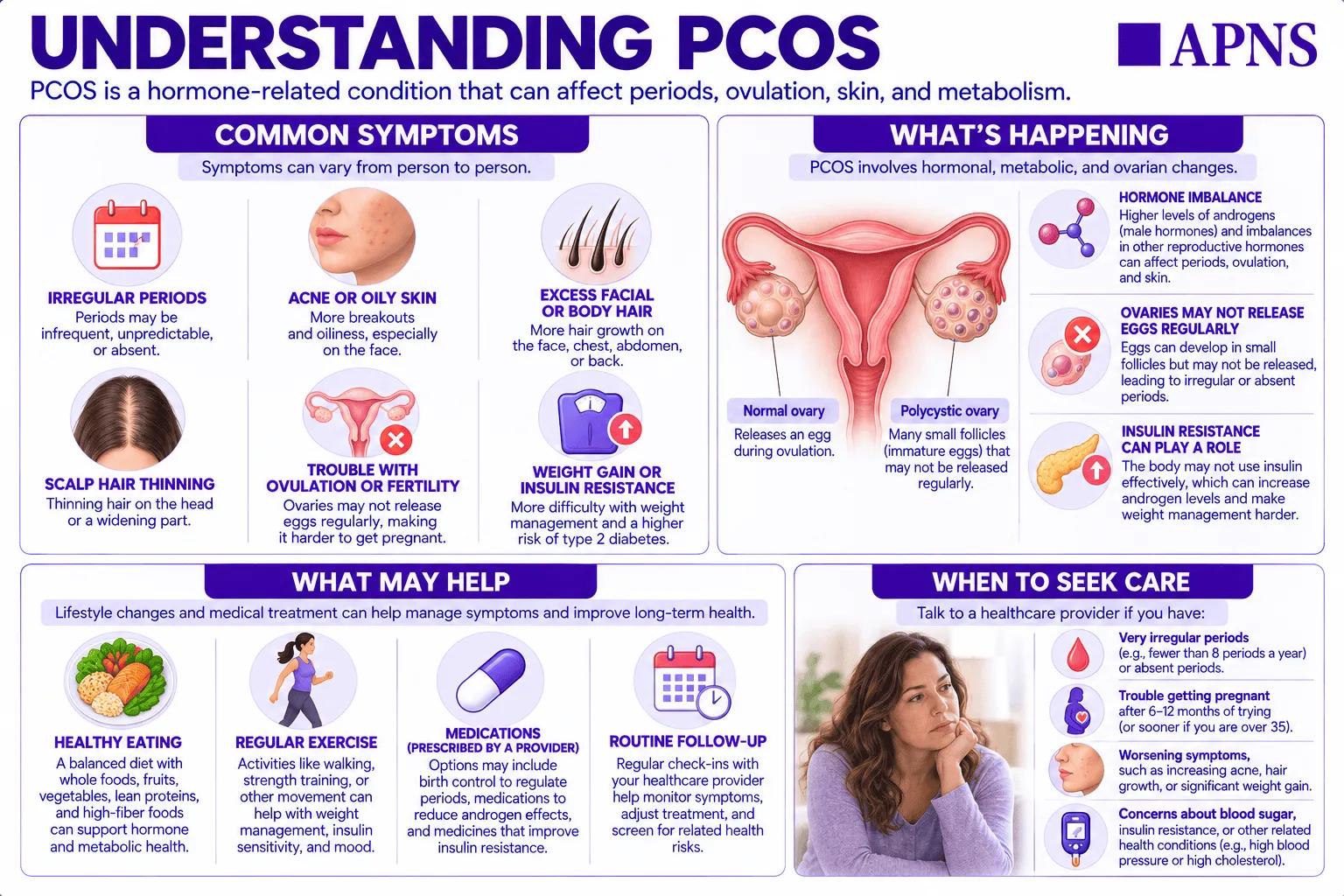 PMOS / PCOS infographic – click to enlarge
What Causes PMOS / PCOS?
There is no single known cause. Genetics, ovarian and adrenal hormone signaling, insulin resistance, and environmental factors appear to interact.
- Higher androgen activity can disrupt ovulation and cause hair or skin symptoms.
- Insulin resistance can raise insulin levels and increase ovarian androgen production.
- Family history increases risk, but no single gene explains every case.
- Weight gain can worsen insulin resistance and symptoms, but weight does not cause every case.
- Inflammation and other hormone pathways may contribute.
PMOS/PCOS is not caused by poor hygiene, personal failure, or one food. It can occur in thin, average-weight, or larger-bodied people.
Learn More
About PCOS/PMOS – NIH NICHD
https://www.nichd.nih.gov/health/topics/pcos/conditioninfo
Explains the reproductive, hormone, metabolic, and whole-body features of this condition.
What Can Make PMOS / PCOS Worse?
Symptoms and long-term risks may worsen with:
- Long gaps between periods without protection of the uterine lining
- Untreated insulin resistance, prediabetes, diabetes, or high cholesterol
- Smoking
- Poor sleep or untreated sleep apnea
- Weight stigma, overly restrictive dieting, or an untreated eating disorder
- Stopping medicine without a plan
- Medicines or conditions that raise androgen levels or disrupt ovulation
- Delaying evaluation of abnormal bleeding or rapidly changing symptoms
Symptoms can change across life stages. Pregnancy, stopping birth control, weight change, stress, and menopause may alter the pattern but do not define the person’s worth or effort.
Learn More
International Evidence-Based PCOS/PMOS Guideline – Monash University
https://www.monash.edu/medicine/mchri/pcos/guideline
Provides international evidence-based recommendations and patient-centered resources for diagnosis and management.
Prevention
PMOS/PCOS cannot always be prevented, but complications can be reduced by:
- Managing infrequent periods to protect the uterine lining
- Checking glucose, cholesterol, and blood pressure as recommended
- Using sustainable nutrition, exercise, sleep, and smoking-cessation support
- Treating sleep apnea
- Using contraception when pregnancy is not desired
- Planning pregnancy and reviewing medicines beforehand
- Seeking early fertility support when desired
- Addressing anxiety, depression, and eating disorders
- Reporting abnormal bleeding or rapidly worsening androgen symptoms
- Keeping long-term follow-up even after periods stop
Care should be free of weight stigma and based on shared decisions. Improvement in health does not require a perfect weight or perfect routine.
Learn More
International Evidence-Based PCOS/PMOS Guideline – Monash University
https://www.monash.edu/medicine/mchri/pcos/guideline
Provides international evidence-based recommendations and patient-centered resources for diagnosis and management.
Diabetes and PCOS – CDC
https://www.cdc.gov/diabetes/risk-factors/pcos-polycystic-ovary-syndrome.html
Explains the connection between PCOS, insulin resistance, prediabetes, and type 2 diabetes.
Learn More About PMOS / PCOS
The following video content is provided to help you better understand this condition. These resources are intended for educational purposes and should not replace personalized medical advice from your healthcare provider.
Labs
Testing helps confirm features, exclude similar conditions, and identify health risks:
- Pregnancy Test: Checks an important cause of a missed period.
- Total and Free Testosterone: Evaluates biochemical androgen excess; other androgen tests may be added.
- TSH and Prolactin: Check thyroid and pituitary causes of irregular periods.
- 17-Hydroxyprogesterone: Screens for nonclassic congenital adrenal hyperplasia when appropriate.
- Glucose Testing: A 75-gram oral glucose-tolerance test is the most accurate test for abnormal glucose regulation in PMOS/PCOS; fasting glucose or A1C may be used when it cannot be done.
- Lipid Panel: Checks cholesterol and triglycerides.
- Other Tests: Cortisol, additional androgens, liver tests, or other studies may be ordered when symptoms are unusual.
Insulin levels are not routinely recommended for diagnosis because available tests are not accurate enough for everyday clinical use. Hormonal birth control can affect androgen results and must be considered when interpreting tests.
Learn More
International Evidence-Based PCOS/PMOS Guideline – Monash University
https://www.monash.edu/medicine/mchri/pcos/guideline
Provides international evidence-based recommendations and patient-centered resources for diagnosis and management.
Diagnosing PCOS/PMOS – NIH NICHD
https://www.nichd.nih.gov/health/topics/pcos/conditioninfo/diagnose
Explains how history, examination, laboratory testing, and sometimes imaging support diagnosis.
Diagnostics
Additional assessment may include:
- Pelvic Ultrasound: Counts ovarian follicles and measures ovarian volume when imaging is needed; ovarian appearance alone does not diagnose PMOS/PCOS.
- Blood Pressure: Checked at least yearly because cardiovascular risk factors are more common.
- Sleep-Apnea Screening: Assesses snoring, unrefreshing sleep, daytime sleepiness, or witnessed pauses in breathing.
- Mental-Health and Eating-Disorder Screening: Identifies common anxiety, depression, body-image distress, or disordered eating.
- Endometrial Evaluation: Ultrasound or biopsy may be needed for prolonged absent periods, abnormal bleeding, or a thickened uterine lining.
Routine repeated ovarian ultrasounds are not needed to monitor PMOS/PCOS. Testing should answer a specific clinical question.
Learn More
International Evidence-Based PCOS/PMOS Guideline – Monash University
https://www.monash.edu/medicine/mchri/pcos/guideline
Provides international evidence-based recommendations and patient-centered resources for diagnosis and management.
Treatment & Management
Treatment Options
Treatment is based on the patient’s priorities, such as predictable bleeding, uterine protection, acne or hair symptoms, metabolic health, pregnancy, contraception, sleep, or emotional well-being.
- Lifestyle Support: Sustainable eating, movement, sleep, and prevention of weight gain benefit health even without weight loss.
- Menstrual Management: Combined hormonal birth control or scheduled progestogen can regulate bleeding and protect the uterine lining.
- Metabolic Treatment: Metformin may help insulin resistance, glucose, and some cycle outcomes.
- Hair and Acne Treatment: Hormonal contraception, anti-androgens, topical products, or hair-removal methods may help.
- Fertility Treatment: Ovulation-induction medicine is used when pregnancy is desired; letrozole is the international guideline’s preferred first-line medicine when no other infertility factor is present.
- Weight-Management Medicine or Surgery: May be considered using general adult eligibility criteria and shared decision-making.
No single treatment addresses every feature. A plan often combines approaches and changes over time.
Learn More
Treatments for PCOS/PMOS – NIH NICHD
https://www.nichd.nih.gov/health/topics/pcos/conditioninfo/treatments
Describes lifestyle care, medicines, hair and acne treatment, and individualized symptom management.
International Evidence-Based PCOS/PMOS Guideline – Monash University
https://www.monash.edu/medicine/mchri/pcos/guideline
Provides international evidence-based recommendations and patient-centered resources for diagnosis and management.
Lifestyle Changes
Healthy behaviors help metabolic, reproductive, and emotional health at every body size:
- Choose an eating pattern that is balanced, affordable, culturally acceptable, and sustainable.
- Include regular aerobic activity and muscle-strengthening exercise.
- Break up long periods of sitting.
- Use realistic goals and track health changes beyond weight alone.
- Build a regular sleep schedule and seek care for possible sleep apnea.
- Avoid smoking and limit alcohol.
- Use weight-neutral support if weight-focused care worsens distress or disordered eating.
- Ask for counseling or dietitian support when helpful.
There is no single best “PCOS diet.” Benefits can occur without weight loss, and any weight-management goal should be respectful and individualized.
Learn More
International Evidence-Based PCOS/PMOS Guideline – Monash University
https://www.monash.edu/medicine/mchri/pcos/guideline
Provides international evidence-based recommendations and patient-centered resources for diagnosis and management.
Medications
Medicines may include:
- Combined Hormonal Contraceptives: Help irregular periods, acne, and excess hair and protect the uterine lining; clot and cardiovascular risks must be reviewed.
- Progestogen: Given on a schedule or through certain contraceptive methods to protect the uterine lining when periods are infrequent.
- Metformin: Improves insulin sensitivity and may support glucose, lipids, and menstrual regularity; stomach effects and low vitamin B12 can occur.
- Anti-Androgens: Spironolactone or other agents may reduce unwanted hair or scalp hair loss; reliable contraception is needed because of fetal risk.
- Letrozole: Common first-line ovulation-induction medicine when pregnancy is desired; it requires clinician supervision.
- Clomiphene or Gonadotropins: Other fertility options used in selected patients.
- Weight-Management Medicines: GLP-1–based or other approved medicines may be considered; effective contraception and pregnancy planning are essential.
No medicine cures PMOS/PCOS. Do not use unregulated “hormone balance” products or supplements without discussing safety, interactions, and pregnancy risk.
Learn More
Treatments for PCOS/PMOS – NIH NICHD
https://www.nichd.nih.gov/health/topics/pcos/conditioninfo/treatments
Describes lifestyle care, medicines, hair and acne treatment, and individualized symptom management.
Treatments for Infertility Related to PCOS – NIH NICHD
https://www.nichd.nih.gov/health/topics/pcos/conditioninfo/treatments/infertility
Reviews medicines and procedures that may help ovulation and pregnancy.
International Evidence-Based PCOS/PMOS Guideline – Monash University
https://www.monash.edu/medicine/mchri/pcos/guideline
Provides international evidence-based recommendations and patient-centered resources for diagnosis and management.
Procedures
Most care does not require a procedure. Options may include:
- Hair-Removal Procedures: Laser therapy or electrolysis may reduce unwanted hair.
- Endometrial Biopsy: Samples the uterine lining when abnormal bleeding or prolonged missed periods raise concern.
- Fertility Procedures: Intrauterine insemination or in vitro fertilization may be used when simpler approaches do not work or another infertility factor exists.
- Laparoscopic Ovarian Surgery: Rarely considered for infertility when medicine is unsuccessful; benefits and risks require specialist review.
- Metabolic or Bariatric Surgery: May be an option for eligible adults using general guidelines and careful reproductive planning.
Removing ovarian cysts is not a routine PMOS/PCOS treatment because the small follicles are part of the hormone pattern, not dangerous cysts that need removal.
Learn More
Treatments for Infertility Related to PCOS – NIH NICHD
https://www.nichd.nih.gov/health/topics/pcos/conditioninfo/treatments/infertility
Reviews medicines and procedures that may help ovulation and pregnancy.
International Evidence-Based PCOS/PMOS Guideline – Monash University
https://www.monash.edu/medicine/mchri/pcos/guideline
Provides international evidence-based recommendations and patient-centered resources for diagnosis and management.
What Should You Expect Long-Term?
PMOS/PCOS is a long-term condition, but symptoms can be treated and health risks reduced. Period patterns and androgen symptoms may change with age, contraception, pregnancy, and menopause, while metabolic risks can continue.
Follow-up includes blood pressure, glucose status every one to three years based on risk, cholesterol, bleeding pattern, medicines, sleep, and mental health. People with PMOS/PCOS have increased risk of endometrial overgrowth and cancer, but routine screening is not recommended without symptoms; cycle management and evaluation of abnormal bleeding are important.
Learn More
International Evidence-Based PCOS/PMOS Guideline – Monash University
https://www.monash.edu/medicine/mchri/pcos/guideline
Provides international evidence-based recommendations and patient-centered resources for diagnosis and management.
Diabetes and PCOS – CDC
https://www.cdc.gov/diabetes/risk-factors/pcos-polycystic-ovary-syndrome.html
Explains the connection between PCOS, insulin resistance, prediabetes, and type 2 diabetes.
What Can You Do At Home?
Helpful self-care includes:
- Track periods, bleeding, acne, hair changes, sleep, and medicine effects.
- Contact a clinician if periods are absent for several months and pregnancy is not the reason.
- Take prescribed progestogen or birth control consistently for uterine protection.
- Use home pregnancy testing when a period is late and pregnancy is possible.
- Build regular meals, movement, and sleep rather than using extreme diets.
- Use gentle skin and hair care and avoid unsafe bleaching or hair-removal methods.
- Monitor blood pressure or glucose at home only when instructed.
- Seek mental-health or eating-disorder support early.
Ovulation can occur unpredictably. Use contraception if pregnancy is not desired, even when periods are irregular.
Frequently Asked Questions
Are PCOS and PMOS the same condition?
Yes. PMOS is the newer name used to highlight the condition’s endocrine and metabolic effects; PCOS remains widely recognized.
Do I need ovarian cysts to be diagnosed?
No. Diagnosis may be made from irregular ovulation and androgen excess after other causes are excluded.
Did my weight cause PMOS/PCOS?
No. The condition occurs at every body size. Weight changes can affect insulin resistance and symptoms but are not the sole cause.
Can I become pregnant?
Yes. Many people conceive naturally or with treatment. Irregular periods do not mean pregnancy is impossible.
Does PMOS/PCOS increase cancer risk?
Long periods without ovulation increase endometrial overgrowth and cancer risk. Overall cancer risk remains low, and regular uterine-lining protection helps.
Is metformin a fertility medicine?
It may improve ovulation in some people, but letrozole is generally the preferred first-line ovulation-induction treatment when no other infertility factor is present.
Will birth control cure PMOS/PCOS?
No. It manages bleeding and androgen symptoms and protects the uterine lining while it is used.
Does everyone with PMOS/PCOS have insulin resistance?
No, but the risk of abnormal glucose regulation is higher, so periodic testing is recommended regardless of body size.

Questions To Ask Your Provider
Consider asking:
- Which diagnostic features of PMOS/PCOS do I have?
- What other conditions have been ruled out?
- Do I need an ultrasound, or are my history and labs enough?
- How often should my glucose, cholesterol, and blood pressure be checked?
- How will we protect my uterine lining if my periods are infrequent?
- Which treatment best matches my goals right now?
- Could my medicines affect pregnancy or require contraception?
- Should I be screened for sleep apnea, anxiety, depression, or an eating disorder?
- What fertility options are available when I am ready?
- Which hair, acne, or scalp treatments are safe?
- What symptoms need urgent evaluation?
Specialist Referrals
Primary care or gynecology can manage many cases. Referral may be made to:
- Gynecologist: For abnormal bleeding, menstrual management, pelvic symptoms, or contraception.
- Endocrinologist: For severe androgen excess, diabetes, unusual hormone results, or complex metabolic disease.
- Reproductive Endocrinology and Infertility Specialist: For ovulation treatment or difficulty becoming pregnant.
- Dermatologist: For acne, excess hair, or scalp hair loss.
- Registered Dietitian: For sustainable nutrition care, diabetes prevention, or eating concerns.
- Sleep Specialist: For suspected obstructive sleep apnea.
- Mental Health Professional: For anxiety, depression, body-image distress, infertility stress, or disordered eating.
- Maternal-Fetal Medicine Specialist: For selected high-risk pregnancies.
Learn More
International Evidence-Based PCOS/PMOS Guideline – Monash University
https://www.monash.edu/medicine/mchri/pcos/guideline
Provides international evidence-based recommendations and patient-centered resources for diagnosis and management.
Is PMOS / PCOS Curable?
There is no permanent cure, but PMOS/PCOS is highly manageable. Treatment can improve periods, protect the uterine lining, reduce acne or unwanted hair, support fertility, and lower diabetes and cardiovascular risk factors.
Symptoms may change over time and may become less noticeable after menopause, but metabolic monitoring remains important. A treatment plan can change as goals change.
Learn More
About PCOS/PMOS – NIH NICHD
https://www.nichd.nih.gov/health/topics/pcos/conditioninfo
Explains the reproductive, hormone, metabolic, and whole-body features of this condition.
Polycystic Ovary Syndrome – World Health Organization
https://www.who.int/news-room/fact-sheets/detail/polycystic-ovary-syndrome
Summarizes symptoms, prevalence, health risks, diagnosis, treatment, and global care needs.
Emergency Symptoms / When To Seek Immediate Help
Seek urgent or emergency care for:
- Very heavy bleeding that soaks through a pad or tampon every hour, fainting, severe weakness, or shortness of breath
- A positive pregnancy test with severe one-sided pelvic pain, shoulder pain, dizziness, or bleeding
- Sudden severe pelvic or abdominal pain with vomiting, fever, or fainting
- Chest pain, trouble breathing, coughing blood, or one-sided leg swelling while using estrogen-containing medicine
- Sudden weakness, facial droop, trouble speaking, vision loss, or a severe unusual headache
- Severe high blood sugar with vomiting, deep breathing, confusion, or dehydration
- Thoughts of suicide, self-harm, or inability to stay safe
PMOS/PCOS itself rarely causes an emergency, but pregnancy complications, severe bleeding, ovarian torsion, blood clots, metabolic illness, and mental-health crises require immediate care.
CALL 911
APNS does not provide emergency medical services. If you believe you are experiencing a medical emergency, including (but not limited to) chest pain, difficulty breathing, stroke symptoms, severe allergic reactions, anaphylaxis, uncontrolled bleeding, seizures, loss of consciousness, or any other potentially life-threatening condition, you are instructed to call 911 immediately or go immediately to the nearest emergency department.
Official Resources / External Links
About PCOS/PMOS – NIH NICHD
https://www.nichd.nih.gov/health/topics/pcos/conditioninfo
Explains the reproductive, hormone, metabolic, and whole-body features of this condition.
Symptoms of PCOS/PMOS – NIH NICHD
https://www.nichd.nih.gov/health/topics/pcos/conditioninfo/symptoms
Reviews irregular periods, androgen-related symptoms, fertility concerns, and metabolic effects.
Diagnosing PCOS/PMOS – NIH NICHD
https://www.nichd.nih.gov/health/topics/pcos/conditioninfo/diagnose
Explains how history, examination, laboratory testing, and sometimes imaging support diagnosis.
Treatments for PCOS/PMOS – NIH NICHD
https://www.nichd.nih.gov/health/topics/pcos/conditioninfo/treatments
Describes lifestyle care, medicines, hair and acne treatment, and individualized symptom management.
Treatments for Infertility Related to PCOS – NIH NICHD
https://www.nichd.nih.gov/health/topics/pcos/conditioninfo/treatments/infertility
Reviews medicines and procedures that may help ovulation and pregnancy.
Polycystic Ovary Syndrome – FDA
https://www.fda.gov/consumers/womens-health-topics/polycystic-ovary-syndrome-pcos
Provides current patient information about symptoms, diagnosis, treatment, and medicine safety.
PCOS – NIH MedlinePlus
https://medlineplus.gov/polycysticovarysyndrome.html
Links to reliable information about symptoms, testing, treatment, fertility, diabetes risk, and genetics.
Polyendocrine Metabolic Ovarian Syndrome – NIH MedlinePlus
https://medlineplus.gov/ency/article/000369.htm
Explains the updated PMOS name and the condition’s reproductive and metabolic effects.
International Evidence-Based PCOS/PMOS Guideline – Monash University
https://www.monash.edu/medicine/mchri/pcos/guideline
Provides international evidence-based recommendations and patient-centered resources for diagnosis and management.
Diabetes and PCOS – CDC
https://www.cdc.gov/diabetes/risk-factors/pcos-polycystic-ovary-syndrome.html
Explains the connection between PCOS, insulin resistance, prediabetes, and type 2 diabetes.
Polycystic Ovary Syndrome – World Health Organization
https://www.who.int/news-room/fact-sheets/detail/polycystic-ovary-syndrome
Summarizes symptoms, prevalence, health risks, diagnosis, treatment, and global care needs.
This guide is for education only and does not replace professional medical advice, examination, diagnosis, or treatment. PMOS/PCOS symptoms overlap with pregnancy, thyroid and pituitary disorders, adrenal conditions, and rare hormone-producing tumors. Seek emergency care for severe bleeding, pregnancy with one-sided pain or fainting, sudden severe pelvic pain, blood-clot or stroke symptoms, severe high blood sugar, or a mental-health crisis. Do not start or stop hormone, metabolic, fertility, or weight-management medicine without clinician guidance.
Get personalized care for PMOS / PCOS
At APNS, our providers take the time to understand your condition and your goals. We offer comprehensive telehealth visits at a fixed rate — no membership fees, no insurance required, and no unexpected charges. Whether you’re newly diagnosed or looking for a provider who actually listens, we’re here to help.